Before time had breath, before stars were flung across the sky, and before the earth had a name, there was only the Eternal. The opening of the Bible is often read as a simple Sunday school story, but the 7 days of creation in Genesis 1 are a masterpiece of structural engineering. This isn’t just a list of events; it’s a definitive account of how the Almighty shattered the silence with a voice that brought forth brilliance from a churning abyss.
To truly understand this account, we have to look past the chronology and see the blueprint. Why does the order of creation actually matter? It matters because it reveals a God who is not reacting to chaos, but meticulously subduing it to prepare a sanctuary for His children. The 7 days of creation show us a God who prepares the environment before He ever introduces the life that will inhabit it.
Table of Contents
The Order of Creation: The Logic of Forming and Filling
If you’ve ever tried to build a house, you know you don’t buy the curtains before you pour tIn the ancient world, “creation” wasn’t just about making physical matter; it was about assigning function. If you’ve ever tried to build a house, you know you don’t buy the curtains before you pour the concrete. In the beginning of the Bible, the Creator follows this principle across the 7 days. There is a beautiful, almost mathematical symmetry to how the world was formed.
The first half of the week was dedicated to “Forming” the spaces:
- Day 1 (The Birth of Time): God spoke, “Let there be light,” and the first sunrise broke the void. He didn’t just create photons; He created the cycle of Time, calling the light Day and the darkness Night.
- Creation Day 2 (The Architecture of Space): The Creator set a firmament—a Raqiya—to divide the waters from the waters. This wasn’t just “making air”; it was a violent act of order that carved out a breathable sanctuary from a world that was rolling endlessly beneath the gaze of the Almighty. More on the Raqiya below.
- Creation Day 3 (The Foundation of Life): The waters were gathered into seas so the dry land could appear. In an instant, the earth bloomed with vegetation and fruit-bearing trees.
By the end of Day 3 of creation, the “pantry” was stocked and the habitat was dry. God was setting the stage for the life that was yet to come.
Filling the Void: How God Population of the Heavens and Earth
The second half of the week is where the “Filling” begins. This is where the days of creation become a profound witness to God’s character as a Provider. He didn’t just create life; He created a home for it.
- Creation Day 4 (The Luminaries): Now that Day 1 had created the framework of “Time,” Day 4 fills that time with the Sun, Moon, and Stars. These weren’t just lights; they were markers for seasons, days, and years.
- Day 5 (The Sanctuary of Wings): Now that Day 2 had created the “Space” of the sky and sea, Day 5 fills them with life. The deep, once empty, became a realm of wonder, and the sky became a sanctuary of wings.
- Day 6 (The Arrival of the King): Now that Day 3 had created dry land, Day 6 fills it with beasts of every kind. But the climax of the order of creation is the creation of man in the image of God.
Humanity was the final piece of the puzzle, placed into a world that had been meticulously designed and prepared for our arrival.
Creation Day 2: The Mystery of the Raqiya (Firmament)
Many readers skip over or do not study Creation Day 2 because it feels like an “empty” day. There are no plants, no animals, and no sun. However, from a theological and structural standpoint, Day 2 is the most authoritative moment of the entire week. It is the day the Almighty secured our existence by establishing a boundary against chaos.
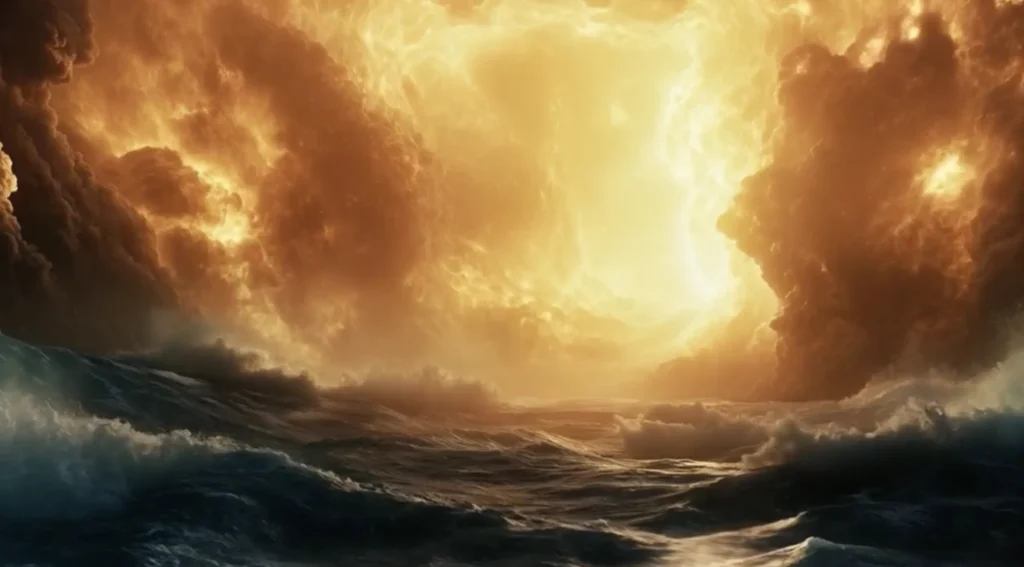
When the world was a vast, churning abyss, it was dominated by the Tehom—the primordial deep. There was no horizon, no breathable air, and no sky; only the infinite, wild waters rolling beneath the gaze of the Creator. To solve this, God spoke the Raqiya into existence.
In the original Hebrew, the word Raqiya (Firmament) comes from a root meaning “to beat out” or “to hammer out,” like a craftsman hammering a sheet of gold. This wasn’t just a gentle appearance of “air.” It was a violent, structural act of order. God was hammering out a divine partition to divide the “waters which were under the firmament from the waters which were above the firmament.”
Why Day 2 Matters for Authority
The order of creation is critical here. Without the Firmament, the “dry land” of Day 3 would have been immediately reclaimed by the deep. The Raqiya created a “bubble of life”, a protected sanctuary, within a universe that was otherwise uninhabitable.
When you watch the cinematic breakdown in the video above, pay close attention to the transition of the waters. This is the moment the King of Glory sets the limits of the deep. It reminds us that our world is a protected domain, not a cosmic accident. The Firmament is the evidence that God didn’t just “make” a world; He moved the chaos back to make a home for us. This is the ultimate signature of a Father who provides safety before He provides life.
The 7th Day of Creation: Why the Almighty Rested
The 7 days of creation reach their climax not with an act of labor, but with an act of rest. In our modern “hustle” culture, we think rest is what we do when we’ve run out of gas. But the Seventh Day wasn’t about exhaustion, the Almighty ended His work because it was finished and “very good.”
In the ancient world, when a King finished his palace, he would “rest” in it to begin his rule. The Sabbath was a day of satisfaction and communion. The order matters because the Sabbath is the goal of the week. We weren’t created to work until we drop; we were created to work from a place of divine rest. By stepping back, God invited us to stop looking at the “stuff” and start looking at the Relationship.
The Two Lenses of Genesis: 1 and 2
As we explore this “Architect’s View” of the universe, it’s important to address a common question: “What are the two stories of creation in Genesis?”:
- Genesis 1 is the “Wide-Angle Lens.” It shows the cosmic scale, the King, and the structural integrity of the 7 days of creation.
- Genesis 2 is the “Macro Lens.” It zooms in from the stars down into the dirt. It’s the difference between seeing a King build his palace and seeing a Father build a nursery.
You need both to understand the full heart of God. One gives you the majesty of the Creator; the other gives you the intimacy of the Father.
The Takeaway
We live in a world that often feels like that original void—chaotic, noisy, and without shape. But the days of creation serve as a permanent reminder that there is a design. Whether you are looking at the linguistic roots of the Hebrew text or the cinematic beauty of the celestial bodies in our video, the message is the same: The order isn’t random. Your life isn’t random.
If the Creator took this much care to prepare the atmosphere of the earth before He even made your ancestors, how much more is He involved in the details of your life today?
Next Steps in the Journey:
The story doesn’t end with the stars. To see how this cosmic Architect became a personal Sculptor who breathed the Nefesh into humanity, check out our deep dive into the Story of Adam and Eve here.
FAQ: The 7 Days of Creation
What did God create on each day?
The order of creation follows a logic of “forming and filling.”
Over the first three days, God formed the heavens, the sea, and the land.
Over the next three, He filled them with the sun, moon, stars, animals, and finally, humanity.
What was the first thing God created?
In Genesis 1:1-3, the first act of creation was calling light into existence.
By creating light first, the Almighty established the cycle of Day and Night, creating the framework of Time itself.
Why is the 7th day of creation different?
Unlike the other six days, the 7th day is a day of divine rest and sanctification.
It marks the completion of the “very good” work and invites humanity into a relationship with the Creator rather than a cycle of labor.
What is the meaning of “Raqiya” in the creation story?
The Raqiya, or Firmament, was created on Day 2 to divide the waters.
It represents a structural boundary that carved out a breathable, protected sanctuary for life to eventually inhabit.
For more cinematic biblical deep dives, subscribe to God Revealed Here on YouTube.