An editorial reference archive of fragmentary witnesses
This page presents an organized archive of surviving manuscript fragments associated with the Book of the Giants tradition.
Because the material survives only in a highly fragmentary state, no continuous text exists. What follows documents what is preserved, where it comes from, and how the fragments relate to one another—without reconstruction or narrative restoration.
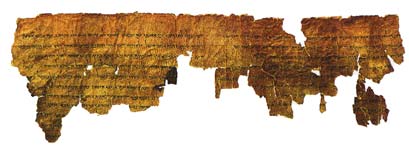
What Survives of the Book of the Giants
The Book of the Giants did not survive as a complete manuscript.
What survives is fragmentary evidence – scattered pieces preserved in the Dead Sea Scrolls corpus and in much later textual witnesses.
This page does not present a preserved manuscript, a transcription, or a critical edition. It provides an organized reference guide to the surviving fragment record, with editorial “English sense” descriptions based on published scholarly editions.
No attempt is made to restore missing lines, reconstruct a continuous narrative, or harmonize fragments into a single readable text.
Fragment Sources: Book of the Giants
The surviving material comes from distinct textual traditions. These sources are not interchangeable and must be read within their historical context.
Qumran (Dead Sea Scrolls)
The earliest surviving fragments of the Book of the Giants were discovered among the Dead Sea Scrolls.
These Aramaic texts originate from the same Second Temple library as fragments of the Book of Enoch.
They contain references to the Giants, their dreams, their fear of destruction, and their appeal to Enoch following the declaration of judgment.
Later Manichaean Witnesses
Additional fragments appear in much later Manichaean literature, preserved in Middle Persian and related languages.
These texts reflect the continuation of the Giants tradition in later communities and are not original Jewish compositions. They are included here as secondary witnesses to the same narrative tradition.
Archival Note on Additional Fragments
In addition to the fragment groups presented here, a small number of highly fragmentary manuscripts are commonly associated with the Book of the Giants tradition, including 1Q23, 2Q26, 4Q529, 4Q534 and 6Q8.
These materials preserve only minimal or isolated text and do not contribute continuous readable content. For clarity and usability, they are not included in this archive but are acknowledged here for completeness.
Read the Surviving Book of Giants Fragments
The fragments below are not presented as primary source material. They are with editorial “English sense” descriptions based on published scholarly editions.
Each fragment includes:
- Fragment identification
- Source tradition
- Translator attribution
- Clean text presentation
No commentary or interpretation is provided.
Fragment Group 4Q203 (Aramaic)
Source: Qumran (Dead Sea Scrolls)
Language: Aramaic
Fragment Group 4Q530–533 (Aramaic)
Source: Qumran (Dead Sea Scrolls)
Language: Aramaic
Manichaean Fragment Witnesses
Source: Later Manichaean Tradition
Languages: Middle Persian, Sogdian, Parthian
Provenance: Central Asia (primarily the Turfan region)
How does the Book of Giants relate to 1 Enoch?
The Book of the Giants is traditionally associated with the Enochic literature found at Qumran. It expands on the narrative of the Nephilim (the offspring of the Watchers) briefly mentioned in the Book of Watchers (1 Enoch 1–36).
Is the Book of Giants part of the Bible?
No, the Book of Giants is considered non-canonical or apocryphal. While it was widely read in the Second Temple period and by Manichaean communities, it is not included in the standard Hebrew Bible or Christian Old Testament.
What are the primary sources for the Book of Giants?
The two main witnesses are the Aramaic fragments found among the Dead Sea Scrolls (specifically 4Q203 and 4Q530) and later Manichaean fragments written in Middle Persian, Sogdian, and Old Turkish.
God Revealed Here presents original written and visual work derived from primary religious texts.
It does not operate as a ministry, publisher, or academic institution.
Material is structured for interpretation through narrative form and visual synthesis rather than doctrinal instruction.